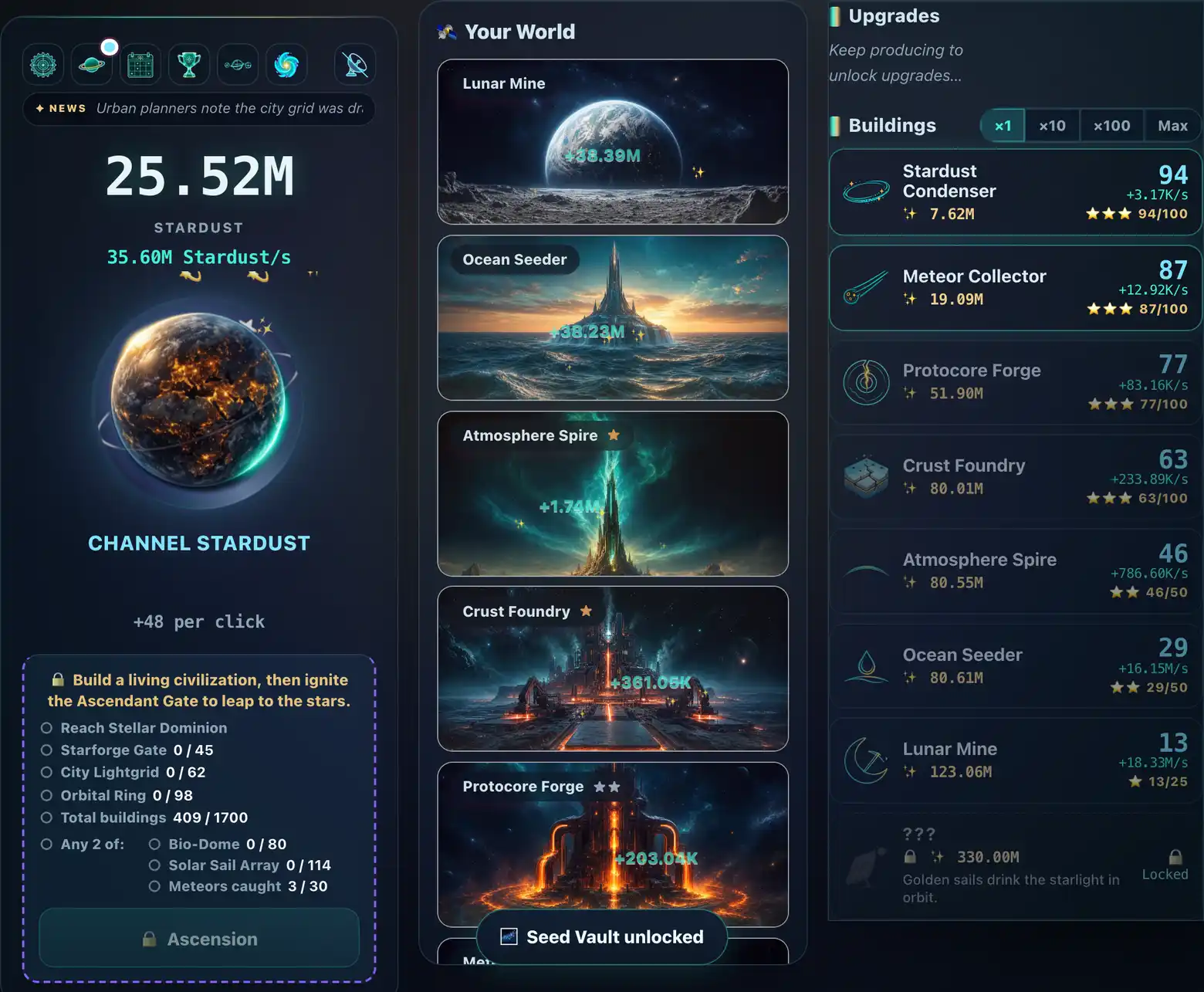
PlanetIdle started with a simple, slightly stubborn idea: an idle game you could actually finish. Not a spreadsheet that grows forever, but a story with a first page and a last one. This is a note about what we were reaching for, and how the thing is put together.
The world
Every game of PlanetIdle opens on a dead rock in the dark — nothing but cold stone and the first faint charge of Stardust. That emptiness is deliberate. We wanted the beginning to feel like almost nothing, so that everything after it feels earned.
What follows is a world coming to life, one stage at a time. The crust cracks open and rivers of magma become the planet's first heartbeat. Steam falls as rain for a thousand years until blue oceans close over the rock. Green creeps across the continents — the first true breath of air. Lights cluster along the coastlines, then a whole world hums: cities, networks, and a species looking up at the stars. Rings of stations lace the sky, solar sails claim the nearby void, and at the very end the Gate ignites and the planet's story opens onto the galaxy. Barren Core, Ocean World, Living World, First Cities, Civilization, the Ascendant Gate — the planet itself is your progress bar, and it visibly becomes each of those things as you play.
The second chapter carries the same arc to Mars: a frozen, rust-red desert dragged, storm by storm, toward something that could hold life. Some of its later stages stay hidden until you reach them — a few things you should get to see for the first time yourself, in your own save, rather than on a page like this one.
An idle game with an ending
Most idle games are built to never stop. You prestige, the numbers reset a little larger, and you climb the same hill again with a bigger multiplier — forever. That loop is genuinely satisfying, and we love plenty of games built on it. But it means the game has no last page. Nothing is ever completed; it's only paused.
We wanted the opposite: a world you grow, a challenge you overcome, and a real ending you can walk away from. So each chapter is a self-contained world with its own story, and finishing it is not about grinding to some enormous number. It's a checklist of goals — reach the final stage, build up your key structures — and then a genuine final challenge you have to win. Clear it and the world flips to its reborn form, the credits roll on that chapter, and you get to take the bow.
Ascension here means starting a brand-new world, not resetting the old one on a treadmill. There is no shard currency to babysit, no infinite prestige spiral. You finish a planet and you move on — and if you never touch the game again after that, we'll consider it a story well told.
How we build it
These worlds are hand-crafted, and we mean that literally. Every stage of every planet is art directed on its own — the exact moment the oceans arrive, the color of the first city-light, the look of a sky finally holding air. Nothing is a recolored placeholder.
Every structure is designed as a beat in that story, not just a bigger number. A meteor collector, an ocean seeder, an orbital ring — each one has a job in the fiction and a job in the economy, and we sweat both. If you're curious about the thinking, we wrote up design notes on every structure — what it is, when it unlocks, and why it exists.
Pacing is the part players feel but never see. We tune it by running the real game engine in simulation — buying the way an actual player would, thousands of times over — so the climb never stalls into a dead wait or trivializes into a straight line. When a stretch feels too slow or a building feels pointless, that shows up in the numbers before it ships. And each chapter gets its own sound: a score and a set of clicks and effects written for that world's mood, because a red-dust survival should not sound like a blue-ocean dawn.
We're two things at once here — players who wanted this game to exist, and the people who have to make every pixel and curve behave. The honest version is that a lot of this is slow, unglamorous craft: nudging a cost multiplier by a hair, redrawing a scene that looked fine but felt wrong. We'd rather do that than ship faster.
What it costs
Chapter 1 — the whole of Earth, barren core to the Gate — is free forever. Not a trial, not a teaser: the complete first world, start to finish, at no charge. There are no ads anywhere in PlanetIdle. Nothing to sit through, nothing tracking you between tabs, no rewarded-video wall between you and your own planet.
Chapter 2, Mars, is a one-time purchase — pay once, own it, and future updates to that chapter are included. No subscription, no energy timers, no second currency you can only buy with real money. We'd rather charge honestly for a finished thing once than nickel-and-dime a free one.
Your saves live in your own browser, in local storage on your device. We don't run accounts and we don't keep your progress on a server. The upside is total privacy and instant play; the trade-off is that clearing your browser data clears your world, so on a big milestone it's worth knowing that's where it lives.
That's the whole deal. Wake a dead rock, grow it into a living world, finish the story — and if it gave you a good quiet hour, that's the point. Thanks for playing.